· Updated
Garden Maintenance Checklist for Pune: Weekly, Monthly and Seasonal
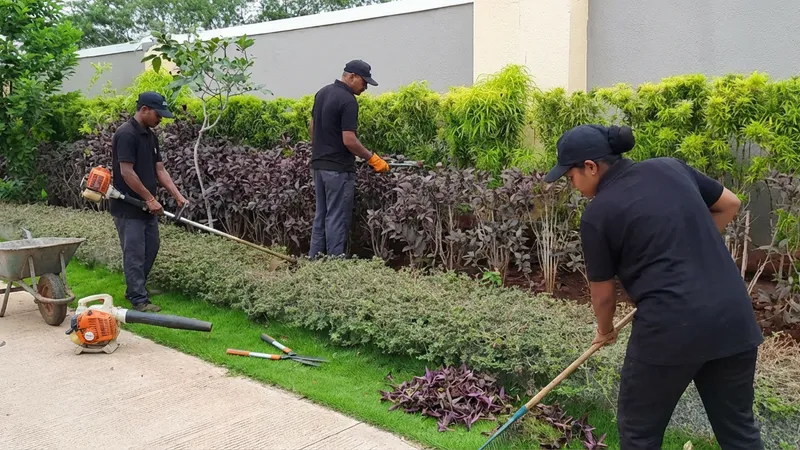
Most garden problems in Pune are not mysteries. They are the predictable result of a task not done at the right time, and almost all of them are cheaper to prevent than to fix.
This is the garden maintenance checklist we work to. It covers what to do weekly, monthly, quarterly and seasonally, what each task actually prevents, and which jobs are worth handing to someone else.
Weekly Checklist
The short list. Fifteen to twenty minutes for most home gardens.
| Task | Why It Matters |
|---|---|
| Water according to season, not habit | Overwatering causes more plant deaths in Pune than drought |
| Two minute walk-through, checking leaf undersides | Mealybugs and aphids are trivial to treat in week one and a project by week four |
| Deadhead spent flowers | Redirects energy into new blooms instead of seed |
| Pull weeds while small | A weed pulled at 5 cm takes seconds; at 30 cm it takes the root system of your plants with it |
| Clear fallen leaves from beds and pot bases | Wet leaf litter is where fungal problems and snails start |
| Mow, during monsoon only | Growth roughly doubles between June and September |
The watering rule that matters most. Push a finger two inches into the soil. If it comes out damp, skip watering. This one habit prevents more root rot than any product you can buy, and it matters most during monsoon when the instinct to stick to a summer schedule is strongest.
Monthly Checklist
| Task | Notes |
|---|---|
| Feed with organic fertiliser | Vermicompost or cow manure, adjusted down in peak monsoon when nutrients leach fast |
| Light pruning and shaping | Little and often beats an annual hack |
| Neem oil spray, preventive | 5 ml per litre with a few drops of liquid soap, more frequently in humid months |
| Check drip lines and emitters | Blocked emitters are usually why one plant is dying while its neighbours thrive |
| Loosen the top soil layer around plants | Pune’s laterite crusts over and sheds water instead of absorbing it |
| Wipe indoor plant leaves | Dust blocks light absorption, and it builds fast in Pune |
| Rotate pots a quarter turn | Stops plants leaning permanently towards the light |
Quarterly Checklist
| Task | Notes |
|---|---|
| Lawn aeration | Essential on compacted laterite; roots cannot penetrate a hard slab of it |
| Topdress with enriched soil mix | Red soil, cocopeat and vermicompost |
| Repot anything root-bound | Roots circling the pot base or emerging from drainage holes |
| Deep-clean pots and trays | Standing water in saucers breeds mosquitoes |
| Review plant placement | Light angles shift through the year; a plant that thrived in June may be scorching in March |
| Inspect for termites and soil pests | Especially around wooden structures and pergolas |
Annual Checklist
- Soil test. Pune’s laterite tends acidic in some pockets and alkaline in others. A test costs little and stops you guessing about yellowing leaves.
- Structural pruning of trees. Once a year, before monsoon, to remove deadwood and reduce wind load.
- Irrigation system service. Full flush of drip lines, replace perished tubing, check the timer.
- Hardscape check. Re-grout stone paths after monsoon, check that paving still falls towards drains.
- Replace spent growing media in containers. Container media compresses and depletes; year-three pots underperform purely because nobody added volume back.
The Pune Seasonal Calendar
Timing is what separates a checklist that works here from one copied off a UK gardening site. Pune’s year has three distinct phases, and the transitions are where the work concentrates.
India Meteorological Department figures put Pune’s average annual rainfall at about 763 mm, with roughly 605 mm falling between June and September. Close to four fifths of the year’s rain arrives in four months. Your garden’s calendar follows that curve.
Pre-Monsoon: May to Early June
The most important fortnight of the gardening year in Pune, and the one most people skip.
- Prune for airflow. Thin out dense growth. Trapped humidity inside an unpruned shrub is where fungal disease starts once the rain begins.
- Clear every drain, channel and gutter. Water that cannot leave will sit on roots.
- Aerate compacted soil. Summer bakes laterite hard. Hard soil sheds monsoon rain rather than absorbing it, so you get runoff and erosion instead of deep watering.
- Apply preventive neem spray. Coating leaves before spores arrive is far more effective than treating an outbreak later.
- Stake tall plants. Pre-monsoon squalls in Pune arrive before the steady rain and take down anything top-heavy.
- Move vulnerable pots. Anything that will waterlog or blow over.
Monsoon: June to September
Not a rest period. It is the busiest season if you want the garden to look good in October.
- Stop watering on schedule. Check soil first, every time.
- Mow weekly, at a raised blade height.
- Weed relentlessly. Weeds germinate within days of the first serious rain and outcompete everything.
- Watch for fungal spots and powdery mildew. August is Pune’s most humid month, averaging close to 88% relative humidity, which is ideal for spores.
- Clear fallen leaves promptly. Wet litter is a pest nursery.
- Check for waterlogging after heavy spells. Standing water for more than a few hours means a drainage problem to fix now, not in October.
Post-Monsoon: October to November
Recovery and reset. The garden is at its fullest and weediest.
- Overseed thin lawn areas and topdress.
- Cut back monsoon overgrowth to a defined shape.
- Resume a normal watering schedule as the rain tapers.
- Assess honestly. This is when it is easiest to see what died, what struggled, and what the drainage did.
- Plant. October to February is Pune’s best planting window. Mild weather lets roots establish before April.
Winter: December to February
The lightest season and the best growing conditions.
- Reduce watering frequency, but water deeply when you do.
- Apply potash-rich feed for root strength.
- Plant winter annuals: petunia, marigold, chrysanthemum, pansy.
- Major pruning and hard cutbacks while growth is slow.
- Start hardscape or landscaping projects. Mortar cures properly and planting establishes well.
Pre-Summer: February to March
- Mulch everything. A two to three inch layer of dry leaves or cocopeat around plant bases cuts evaporation from the soil surface by more than half.
- Set up or service drip irrigation before you need it.
- Raise mowing height. Longer grass shades its own roots.
- Plan shade for anything that struggled last April.
What Each Task Actually Prevents
Checklists get ignored when the reason is missing. The short version:
Weeding is not tidiness. Weeds take water and nutrients from a soil that already drains nutrients fast, and a thin lawn loses ground to them quickly.
Aeration is not optional here. Laterite compacts to the point that water runs off the surface and roots stay shallow. Shallow roots mean a garden that browns fast in April.
Pruning for airflow is monsoon disease prevention. A dense plant holds humidity in its interior like a greenhouse.
Deadheading redirects a plant’s energy from seed production back into flowering.
Mulching is your summer water bill and your plants’ survival margin in one job.
What to Do Yourself, What to Hand Over
Worth being honest about the split.
Reasonable to do yourself: watering, deadheading, light weeding, leaf clearing, wiping indoor leaves, checking for pests, basic feeding.
Worth handing over: tree pruning above head height, anything needing a ladder, lawn aeration on compacted soil, drainage correction, diagnosing a plant failing for no obvious reason, and pest problems that have already spread.
Must be handed over: tree removal. Under the Maharashtra (Urban Areas) Protection and Preservation of Trees Act, 1975, cutting a tree requires permission from the Tree Authority through the Pune Municipal Corporation, and doing it without is an offence. This applies to trees in your own garden.
If a garden has been let go for months, a checklist will not rescue it. Start with a one-time garden cleaning to get back to a baseline, then run the checklist from there. Trying to restart weekly maintenance on an overgrown garden is how people give up in week two.
Garden Waste: What to Do With the Clippings
Every task on this list produces green waste, and where it goes matters more than it used to.
For a household, composting is the obvious answer. Clippings, leaves and kitchen scraps become the vermicompost the beds need, which removes a recurring cost. It also makes you eligible for a PMC property tax rebate: under Section 140(B) of the Maharashtra Municipal Corporations Act, one eco installation from solar, rainwater harvesting or vermicomposting earns 5% off your property tax, and any two earn 10%.
For housing societies the picture is regulatory. Under the Solid Waste Management Rules, bulk waste generators, defined as premises above 20,000 square metres or generating more than 100 kg of waste a day, are required to process wet waste on site through composting or biomethanation. PMC has issued notices to establishments in this category, with around 1,125 identified across the city, though enforcement timelines have shifted after societies raised concerns about space and infrastructure.
If you sit on a society committee, garden clippings are the easiest input to start with. Our society garden maintenance contracts include composting setup and running it, rather than treating it as a separate project.
Burning garden waste is not an option worth considering. It is bad practice, bad for neighbours, and in a city already dealing with winter air quality, indefensible.
When the Checklist Becomes Someone Else’s Job
There is a point where doing this yourself stops making sense: usually when the garden is large enough that weekly tasks take more than an hour, or when nobody in the house genuinely enjoys it.
Monthly garden maintenance in Pune starts at ₹1,000 for a balcony or small terrace and runs ₹2,500 to ₹5,000 for an independent house garden. Set against what a neglected garden costs to bring back, which is usually ₹15,000 and up once the lawn needs re-laying, it is the cheaper path for most people. Our guide to garden maintenance cost in Pune breaks the rates down by property type.
For a specific season, our monsoon garden care guide goes deeper on the hardest four months of the year.
Where the garden is changes how much of this list you can realistically skip. Society common areas in Pimpri-Chinchwad and along NIBM Road need the quarterly and annual items handled on a schedule because no single resident owns the job. Established gardens in Aundh and Kothrud tend to need less weekly work and more attention to soil, since the planting is already mature.
Want someone to run this checklist for you? Call +91-9503620110 or book a gardener online and pick your own slot.
Sources: Rainfall and humidity figures from India Meteorological Department, Pune climate normals: about 763 mm average annual rainfall, roughly 605 mm between June and September. Tree removal requirements under the Maharashtra (Urban Areas) Protection and Preservation of Trees Act, 1975, administered locally by the PMC Tree Authority. Bulk waste generator thresholds under the Solid Waste Management Rules, as applied by PMC. Property tax rebate terms as announced by the Pune Municipal Corporation under Section 140(B) of the Maharashtra Municipal Corporations Act. Task frequencies and maintenance rates reflect Pune Greens practice as of August 2026.
Frequently Asked Questions
What should be on a weekly garden maintenance checklist?
What garden maintenance tasks are seasonal in Pune?
How often should I mow my lawn in Pune?
Which garden jobs actually need a professional?
What happens if I skip garden maintenance for a few months?
Do housing societies in Pune have to compost garden waste?
Need Professional Help?
Pune Greens offers these related services in Pune:
- Garden Maintenance in Pune from ₹1,000/month
- Garden Cleaning in Pune from ₹2,000/visit
- Lawn Care in Pune from ₹30/sq ft
Have Questions About Your Garden?
Talk to our experts. We'll help you figure out the right approach for your space and budget.